Scalable PDF Generation: Implementing a Webhook-Driven Architecture
 Subham Jobanputra
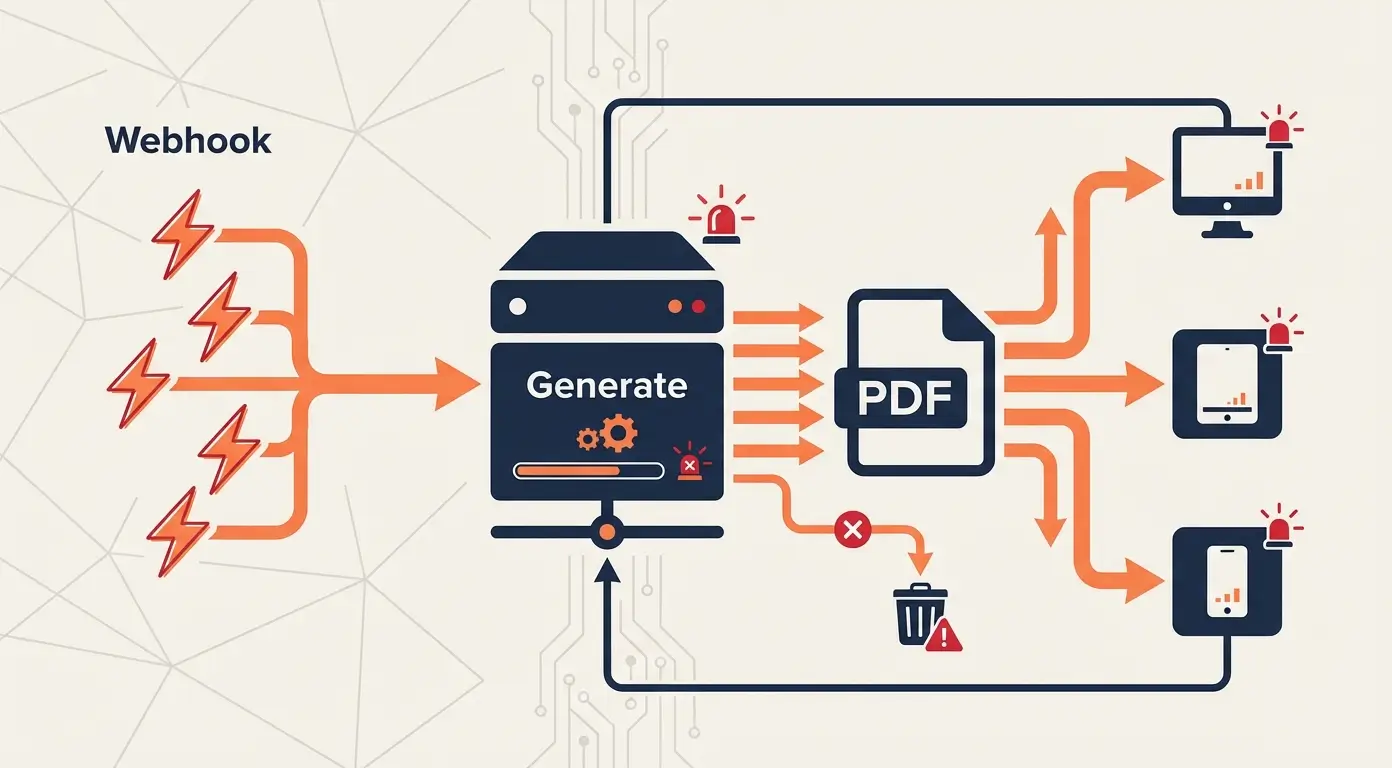
Generating documents on-demand in a monolithic application creates a single point of failure. As user volume increased, our report generation endpoint became a bottleneck, causing timeouts and inconsistent delivery. We needed a decoupled, scalable solution for PDF generation that could handle high concurrency without degrading the user experience.
The Problem: Synchronous PDF Generation in a Monolith
Initially, our application handled PDF generation synchronously within the main request-response cycle. A user would click "Export Report," and the server would block until the PDF was generated and uploaded. This worked for low traffic but introduced significant latency—often 10 to 20 seconds—during peak hours.
Limitations of the Existing Approach
- Request Timeouts: HTTP clients (browsers, API consumers) typically timeout after 30-60 seconds, leading to failed exports.
- Resource Contention: Heavy CPU usage for rendering PDFs impacted other concurrent API requests.
- Lack of Retry Logic: If the generation failed mid-process, the user had to start over.
Evaluating Architecture Decisions
We evaluated three primary strategies for offloading this workload: direct client-side PDF generation (limited by browser memory), a custom background worker (complex to maintain), and an event-driven approach. The event-driven approach, specifically using a pdf generation webhook pattern, offered the best balance of decoupling, scalability, and reliability.
Key Trade-offs Considered
- Complexity vs. Control: Managing our own worker queue added operational overhead. Using a third-party webhook service reduced complexity but introduced external dependency.
- Cost Structure: We moved from a fixed server cost model to a usage-based pricing model common with SaaS document generators.
The Webhook-Driven Solution
We redesigned the workflow to follow an asynchronous pattern:
- API Request: The client requests a PDF generation via a lightweight endpoint.
- Event Queue: The request is pushed to a background queue (e.g., RabbitMQ, SQS).
- External Processing: A dedicated PDF generation service consumes the event.
- Callback (Webhook): Upon completion, the service calls a configured URL with the PDF metadata and download link.
Webhook Endpoint Implementation
The receiving endpoint needs to be idempotent and secure. Here is a simplified structure of the logic:
// Pseudocode for webhook handler
POST /webhooks/pdf-complete

Headers:
  X-Signature: HMAC_SHA256(payload, secret)

Body:
  {
    "status": "completed",
    "document_id": "doc_123",
    "url": "https://cdn.service.com/file.pdf",
    "pages": 5
  }
Before vs. After Comparison
| Metric | Synchronous (Before) | Webhook (After) |
|---|---|---|
| Max Concurrent Users | ~50 | 500+ |
| Avg. Response Time | 12 seconds | 200ms (Initial Request) |
| Failure Rate | High (Timeouts) | Low (Retries implemented) |
Results and Outcomes
By shifting to a webhook architecture, we reduced server load by 40% and eliminated timeout errors. The user experience improved significantly; clients received an immediate acknowledgment with a promise of delivery, and the PDF arrived in their inbox or notification center seconds later.
Lessons Learned
- Security is Critical: Webhook endpoints are public-facing. We implemented signature verification to prevent spoofing attacks.
- Idempotency Matters: Webhooks can be retried by the sender. Handlers must ensure duplicate events don't corrupt data.
- Observability: We added logging for every webhook event to trace the lifecycle of a document generation request.
Conclusion
Implementing a pdf generation webhook architecture transformed a brittle, monolithic feature into a resilient, scalable service. For technical decision-makers, the lesson is clear: as document generation volume grows, decoupling processing from the request cycle is not just an optimization—it is a necessity for reliability.