PDFRise vs Puppeteer: A Performance and Cost Breakdown for Developers
 Subham Jobanputra
Introduction
Generating PDFs programmatically is a common but often overlooked backend challenge. In our platform, we needed a reliable, scalable solution to convert dynamic web reports into printable documents. Initially, we relied on Puppeteer, a headless Chrome Node.js library, for its flexibility and direct control over rendering. However, as our user base grew, the operational overhead—scaling browser instances, managing memory, and handling latency—became a significant drain on resources. This led us to evaluate PDFRise, a dedicated PDF generation API, as a potential alternative. This post details our decision-making process and a direct comparison of speed, cost, and developer experience.
Background: Our Puppeteer-Based Approach
For years, Puppeteer has been the de facto standard for developers needing to capture web content as PDFs. Its power lies in providing a full headless Chrome environment, allowing us to render complex HTML, CSS, and JavaScript with near-perfect fidelity. We implemented this by spinning up Node.js containers that launched Puppeteer instances. We controlled everything: viewport size, print styles, headers, and footers. This approach offered maximum flexibility and was entirely self-hosted, giving us the illusion of control and low per-document cost after initial infrastructure setup.
The Hidden Costs and Pain Points
While Puppeteer provided excellent output quality, the operational reality was complex. Our core pain points were:
- Resource Intensity: Each browser instance is a memory hog. To handle concurrent requests, we needed a large container pool, leading to underutilized resources during low-traffic periods.
- Scaling Complexity: Implementing a robust job queue and process manager to avoid crashes and ensure timely PDF delivery required significant engineering effort.
- Latency: The overhead of launching a browser and rendering a page (even headlessly) introduced latency we couldn't consistently meet for low-TTFB requirements.
- Maintenance: Keeping Chromium versions aligned with Puppeteer API updates and managing OS dependencies in our containers was a recurring maintenance task.
The Decision Framework
Our decision to evaluate an alternative wasn't about replacing functionality but about offloading complexity. We defined our criteria for a new solution:
- Performance: Reduce the 95th percentile of PDF generation time.
- Cost Predictability: Shift from fixed infrastructure costs (servers) to variable, usage-based pricing.
- Developer Experience (DX): Reduce code complexity and eliminate browser management from our application logic.
- Reliability: Achieve higher success rates and better error handling for edge cases.
Evaluating PDFRise as a Solution
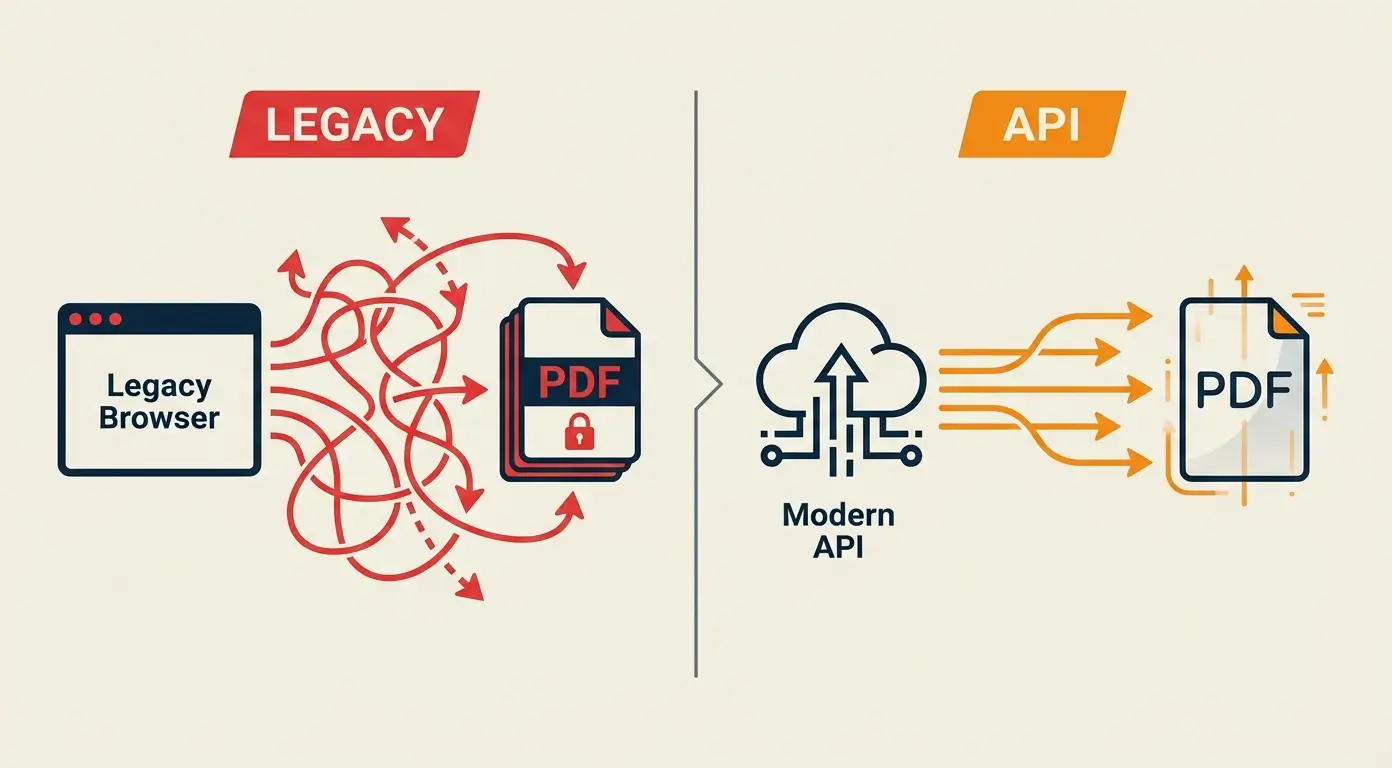
PDFRise positions itself as an API-first service designed for programmatic PDF generation. Unlike Puppeteer, it abstracts the entire rendering engine. Instead of managing a headless browser, we send an HTML payload or a URL via a REST API and receive a PDF in response. This architectural shift from managing processes (Puppeteer) to making requests (PDFRise) was the fundamental change we needed to evaluate.
Comparative Analysis: PDFRise vs Puppeteer
We conducted a small-scale proof of concept, generating a standard 5-page report with charts and tables. Here’s how they stacked up.
Speed and Latency
Puppeteer: Our average PDF generation time was approximately 2.5 seconds. This included the time to launch the browser instance and render the page. During peak concurrency, this time could spike, and memory leaks occasionally caused failures.
PDFRise: The average API response time was under 1.2 seconds. The service was optimized for rendering, and since we weren't waiting for a browser to launch, the time-to-first-byte was significantly lower. The network overhead of an API call was negligible compared to the browser initialization cost.
Cost Analysis
Puppeteer: The direct cost is server time and memory. For high-volume rendering, this requires a dedicated fleet of containers, which costs money whether they are used or not. Indirectly, the engineering hours spent on scaling and maintenance add substantial cost.
PDFRise: Uses a usage-based pricing model (per page or per 1,000 pages). For us, this translated to a predictable monthly cost that scaled linearly with revenue-generating activity. There was no idle capacity cost. For small volumes, it is practically free; for high volumes, the cost is significantly lower than provisioning equivalent compute.
Developer Experience and Ease
Puppeteer: Requires writing and maintaining script logic for launching browsers, handling page context, and managing errors. The codebase requires knowledge of browser internals and Node.js event loops.
PDFRise: The integration is minimal. We replaced a 50-line Puppeteer function with a simple HTTP POST request. The API provided consistent results without us needing to debug CSS rendering quirks in different Chrome versions.
Results and Outcomes
After migrating our batch report generation to PDFRise:
- Throughput increased by 40% due to reduced rendering latency.
- Infrastructure costs dropped by ~60% as we could decommission the dedicated scaling fleet.
- Code complexity was reduced, allowing our team to focus on core product features rather than PDF generation infrastructure.
Lessons Learned
The trade-off was the loss of direct control over the browser environment. Custom print media queries or very specific CSS hacks were sometimes harder to tweak via an API. However, for standard business reports, the out-of-the-box formatting was sufficient. The key lesson was recognizing that not all infrastructure needs to be owned. Commodity tasks like PDF rendering, especially when high performance is required, are often better suited for a specialized service than a self-hosted tool.
Conclusion
Choosing between PDFRise and Puppeteer comes down to a classic engineering decision: build vs. buy. Puppeteer offers ultimate control but demands significant operational investment. PDFRise offers a streamlined, high-performance API that shifts the burden of scaling and optimization to the vendor. For teams looking to decouple PDF generation from their core application logic and optimize for speed and predictable costs, exploring a managed service like PDFRise is a strategic move that pays dividends in focus and scalability.