Build vs Buy for PDF Generation: An Engineering Cost Analysis
 Subham Jobanputra
Build vs Buy for PDF Generation: An Engineering Cost Analysis
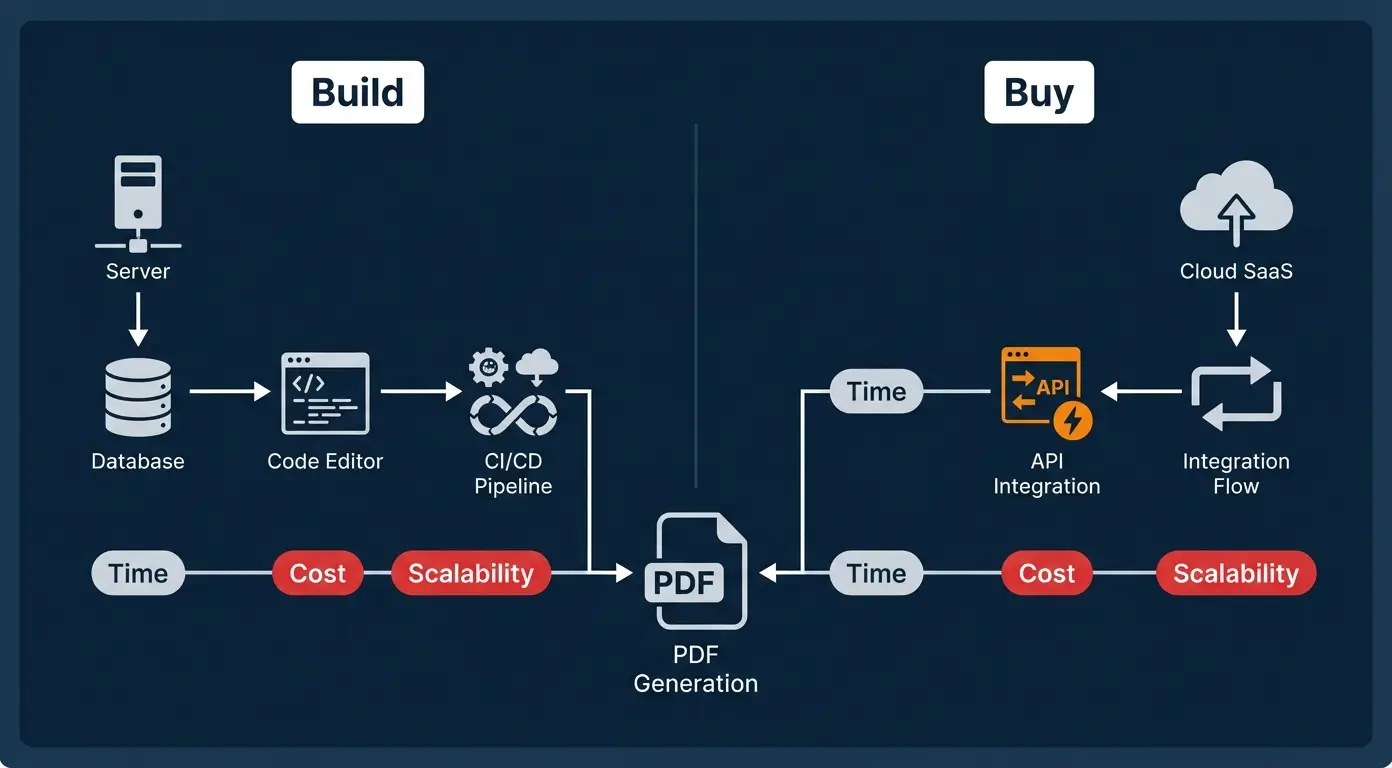
For development teams, the decision to build an internal tool versus purchase an external service is a recurring challenge. PDF generation is a particularly common example where the initial technical task—converting HTML or data into a PDF—can deceptively mask significant operational overhead. This analysis documents the engineering trade-offs and total cost of ownership (TCO) for two approaches: building a custom microservice and using a managed PDF generation API.
The Initial Requirement
Our project required high-fidelity PDF generation for invoices, reports, and documentation. The inputs were primarily dynamic HTML templates populated with API data. The non-functional requirements included consistent rendering, horizontal scalability, security (data privacy), and predictable latency. The timeline for the MVP was set at six weeks.
Option 1: Building an In-House Service
The engineering team estimated the effort to build a robust service using an open-source headless browser engine.
Technical Stack
- Runtime: Node.js (Puppeteer) or Python (Playwright).
- Infrastructure: Containerized microservice deployed on Kubernetes.
- Storage: S3-compatible object storage for generated PDFs.
Development Effort
Initial coding for the endpoint, template rendering, and basic PDF output was estimated at two weeks. However, engineering reality quickly diverged from the estimate:
- Memory Management: Headless browsers are memory-intensive. Implementing a queue system (e.g., BullMQ) was necessary to manage concurrent requests without crashing the process.
- Font Management: Handling custom fonts and internationalization required setting up a font registry within the container and ensuring rendering consistency across OS environments.
- CSS Handling: Print-specific CSS rules (e.g.,
@media print) and handling page breaks required extensive testing and iteration.
Operational Overhead
Beyond development, maintaining the service introduced ongoing costs:
- Browser Updates: Keeping the underlying browser engine compatible with security patches and modern CSS features.
- Scaling: Dynamic scaling of the browser instances to handle load spikes, which differs from standard stateless API scaling.
- Error Tracking: Debugging rendering issues (white screens, broken layouts) required custom logging and screenshot comparison tools.
Option 2: Buying a Managed Solution
The alternative was using a dedicated PDF generation API. These services abstract the rendering engine and infrastructure.
Integration Effort
Integration typically involves sending an HTML payload or a URL to an endpoint. The effort is generally front-loaded into:
- API Wrapper: Building a thin adapter layer in the application code to standardize requests.
- Security: Ensuring API keys are managed securely and data privacy compliance (SOC2, GDPR) is met.
Cost Structure
Pricing is usually tiered based on volume (per document or per page). For a moderate volume (1,000–10,000 documents/month), the cost is predictable but scales linearly with usage.
Comparative Analysis
| Factor | Build (In-House) | Buy (SaaS) |
|---|---|---|
| Initial Development | High (4–6 weeks engineering time) | Low (1–3 days integration) |
| Maintenance | Continuous (Browser updates, bug fixes) | Zero (Vendor handles infrastructure) |
| Time to Market | Slow | Fast |
| Customization | Unlimited | Constrained by API capabilities |
| Cost (Low Volume) | High (Salaries + Infra) | Low to Medium |
Decision and Outcomes
After auditing the projected engineering hours, we selected a hybrid approach for the MVP: we purchased a PDF generation API to meet the immediate launch deadline. This allowed the frontend team to finalize templates without waiting for backend infrastructure.
However, for a long-term roadmap feature requiring extreme customization (specifically, embedding dynamic charts in PDFs that exceeded standard library capabilities), we allocated resources to build a specialized renderer. This compartmentalized the "build" effort to high-value, unique differentiators rather than commoditized PDF creation.
Lessons Learned
- The "Hidden" DevOps Cost: Building a PDF service is not just writing code; it is maintaining a complex, stateful application. The operational burden often exceeds the initial development estimate.
- Commoditize First, Differentiate Later: Standard document generation is a commodity. Investing capital here rarely yields a competitive advantage. Save engineering cycles for core product logic.
- Migration is Possible: Starting with a vendor does not lock you in permanently. A clean abstraction layer allows for a future switch to an in-house solution if volume or customization needs justify it.
Conclusion
For most technical teams, buying a PDF generation solution for standard document needs is the pragmatic choice. The build route is only viable if the PDF generation is a core, revenue-driving feature with unique requirements that existing APIs cannot support. By analyzing the total cost of ownership—including the time value of engineering resources—the "buy" decision often preserves more capital and focus for the product's core value proposition.